ROYAL COLLEGE OF PODIATRY
Dispatch from Brighton: The RCPod at TUC Congress 2026
From NHS pay and employment rights to self-employed workers and professional autonomy, the Royal College of Podiatry took its place alongside the wider trade union movement at TUC Congress 2026 in Brighton.

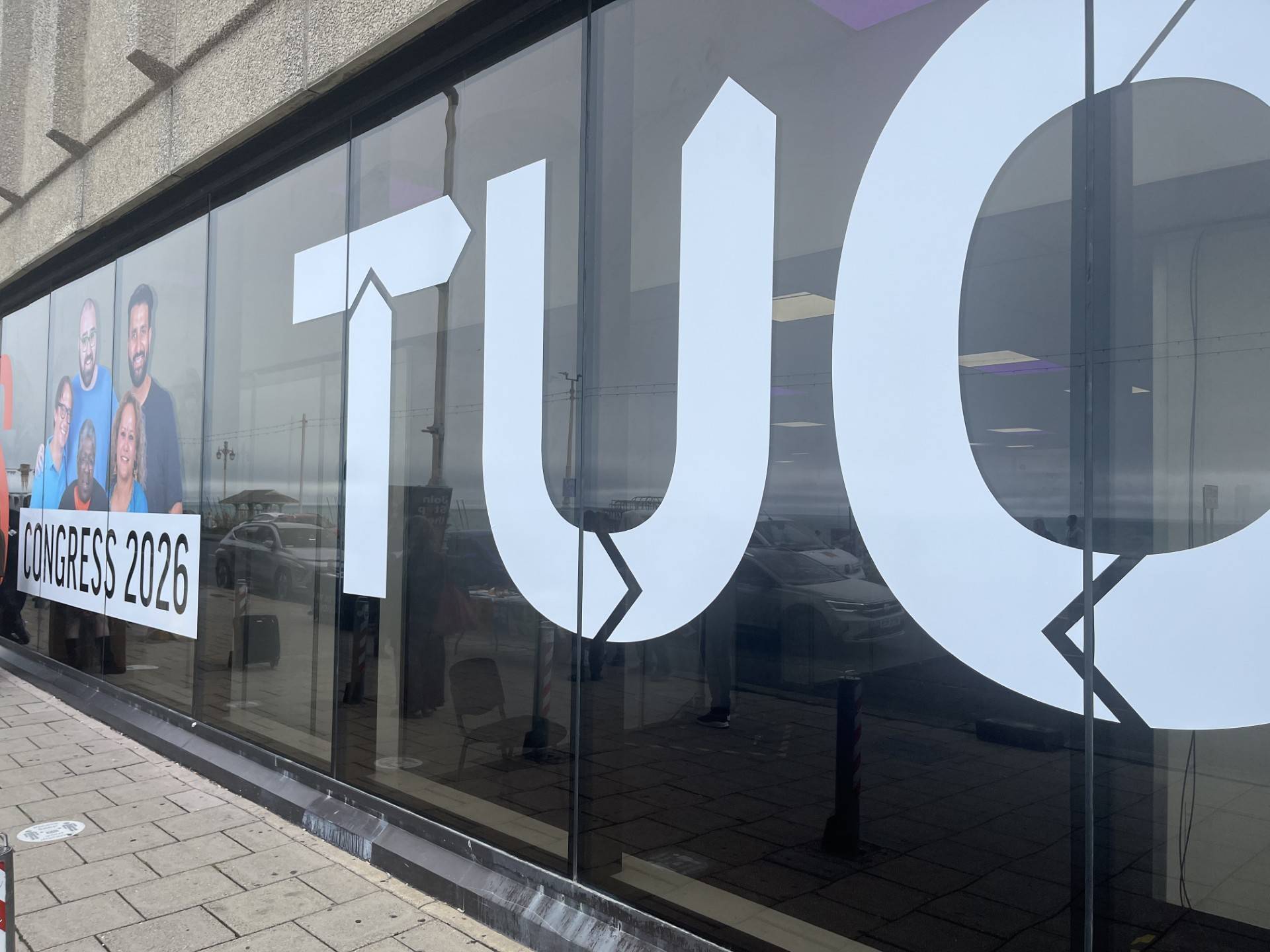
Brighton, 14 September
A dense, low-hanging cover of cloud smothered the Brighton Centre on the city's seafront. The humidity in the mid-September air carried more than a hint of salt from the sea – and from the fish and chip shops nearby.
The TUC Congress was back in town.
There is always something of a start-of-term feeling about Congress. It coincides with the return of Parliament, the end of the traditional summer holidays and the beginning of political party conference season, when politicians, journalists, campaigners and assorted lanyard-wearers begin their annual migration around Britain's conference centres.
For three days in Brighton, it was the trade union movement's turn.
Congress brings together the unions affiliated to the TUC. There are the big beasts – GMB, Unite and UNISON – alongside unions representing people working in health, education, the arts, transport, industry, journalism, commercial services, the civil service and public services.
And, of course, podiatry.
The Royal College of Podiatry was here, debating and voting on issues affecting working people, supporting other unions and putting podiatrists themselves behind the Congress microphone.
‘Unity works’
Nineties nostalgia is at its zenith. So, it was to the instantly recognisable strains of All Together Now, the 1990 hit by The Farm, that TUC General Secretary Paul Nowak rose from his place on the main stage and walked to the podium.
It was an appropriate choice of music.
“Unity Works” is the theme of this year's Congress. Nowak's argument was essentially that when workers organise collectively, things change.
He began with outsourced NHS workers at Chase Farm Hospital, describing insecure contracts, limited sick pay and pensions and what he called a lack of basic respect at work.
From there, he widened his lens.
Union membership, he told Congress, had risen by 192,000 – the biggest increase since records began.
Part of the TUC General Secretary's job is to make the bigger political argument beyond the people already sitting in the hall. Nowak ranged across tax, employment rights, public ownership, industry and climate change.
After the hottest summer on record, he pointed to firefighters tackling wildfires, railway workers dealing with buckling tracks, nurses fainting in hospitals and bus drivers working in extreme heat.
“It is time for a maximum legal working temperature,” he said.
Eventually, he returned to the theme.
“Unity works.”
And after a final appeal to those who had not yet joined a union, there were two words left.
“Solidarity everyone.”
Around him, the Brighton Centre rose to its feet.
A first date with Congress
For Paul Robinson, an advanced specialist podiatrist with Birmingham Community Healthcare NHS Foundation Trust, this was a Congress of firsts.
First time as a delegate. First time speaking from the vast Brighton Centre stage. And, as he stood to move Motion 47 on NHS pay, he acknowledged that it felt a little like something else.
“This feels like a first date, Congress, and it's a long time since I had one of those.”
There was just one problem.
He was about to break one of the golden rules of first dates.
“I am about to talk about pay and politics.”
But behind the joke was a more personal story.
Robinson told Congress about his daughter Emily, who had received NHS care for anorexia as a teenager. About his brother, whose life had been transformed by a kidney transplant. And about his mother, who continues to live independently in her 80s after having a stroke.
He told delegates he was proud to work for the NHS but argued that years of austerity and below-inflation pay increases had contributed to staffing shortages and made it increasingly difficult to recruit and retain NHS staff.
At the heart of the motion was the system used to determine NHS pay.
Robinson called for something “transparent, properly funded and responsive to the true cost of living”. The motion asked the TUC to work with NHS unions and governments across the UK on pay systems capable of delivering “fair and decent pay”.
Seconded by the GMB and supported by UNISON, Motion 47 was carried.
Away from the conference floor
Congress isn't confined to what happens on the main stage.
Go out of the hall during a break and the formal business gives way to something rather different.
There are booksellers, shelves piled high with histories of the trade union movement and work. Stands are occupied by unions, educators, political parties, researchers, public policy organisations and campaigners.
There is even a prize for the best stand.
Outside, a smattering of people attempt to press flyers into the hands of passing delegates, advertising fringe meetings on whatever cause has brought them to Brighton. It is a place of ideas.
This year's fringe sessions provide something of a snapshot of the questions occupying the world of work in 2026. The subjects are nothing if not eclectic. Negotiating AI in the workplace. The skills Britain will need by 2050. What happens when hate comes to work. And what turns a union member into a representative.
And through it all moves the media. Camera crews, reporters, tripods and microphones move between interviews and speeches, with the BBC's political correspondent Iain Watson among those covering the day's developments.
Back inside, another podiatrist was about to address Congress for the first time. An inpatient lead podiatrist from East Sussex Healthcare Trust.
Hard-won rights
“Good morning, Congress. Jodie Lucas from the Royal College of Podiatry, first-time delegate, first-time speaker.”
Then she reached back more than two centuries.
Quoting Thomas Paine, Lucas spoke for the College in support of a composite motion on strengthening and protecting hard-won employment rights for all workers.
“These are not optional extras or a ‘perk’ of the job,” she told Congress. “They are fundamental workers' rights.”
Lucas argued that equality, health and safety and employment protections had been built through years of campaigning and organising.
And she gave one of the numbers some geography.
TUC estimates, she said, suggest the Health and Safety at Work etc. Act 1974 has prevented 114,000 work-related deaths – just under the population of Tunbridge Wells and slightly more than Worthing, a few miles along the coast from Congress.
“These are not insignificant numbers. This is the size of a large UK town.”
The composite called for the trade union movement to be prepared to defend existing employment rights against attempts by future governments to weaken them.
At the end, Lucas returned to Paine.
“It is our duty to guarantee as well as to possess.”
The RCPod supported the composite alongside RMT and Equity. It was carried.
When staffing becomes a safety issue
Some of the College's work at Congress involved standing alongside other health professions.
The College supported Safe staffing equals safe care, a motion from the Royal College of Midwives (RCM) on pressures facing UK maternity services.
The RCM cited survey findings in which 93% of maternity staff said staffing levels affected the quality of care they could provide, while 77% said their unit had been unsafely staffed during the survey week.
Its argument was that safe staffing was not simply a workforce issue. It was also about patient safety, women's health and workers' rights.
The College supported the motion alongside the POA, the prison officers' union. It was carried.
Similar questions surfaced elsewhere.
Physiotherapists and radiographers debated student loans, graduate guarantees and the NHS workforce. The FDA turned to management in the NHS. Another motion called for better parental and kinship-carer leave, including wider access for people on low pay, in insecure work and those who are self-employed.
For podiatry, that last group matters.
The self-employed podiatrist
Not every podiatrist works for an employer.
Many College members are self-employed, while others combine independent practice with employment.
It is one reason the Royal College supported a composite motion originally brought by Equity.
Martin Furlong, the College's Deputy General Secretary, stood to support Composite 3 on fully self-employed workers.
He began with former RMT General Secretary Mick Lynch.
“If you have to get up when the alarm clock rings and go out and do a job – and you depend on your earnings, rather than your assets – you are working class.”
For Furlong, that included self-employed podiatrists.
“We have a very large proportion of our members who are self-employed and they are working people who need protection,” he told Congress.
Podiatrists, he said, might choose permanent employment, self-employment or “a bit of both”. But they could make those choices without fully understanding the differences between them or what being genuinely self-employed meant.
The College backed calls for unions and the TUC to provide better information and guidance about rights at work.
Furlong was careful about where that should stop.
“To be clear, I am not talking about tax – we aren't experts in that – but in rights at work.”
He pointed to Equity as evidence that trade unions could organise and support self-employed workers.
“Let's make sure that we look after our self-employed members,” he concluded, “and give them the dignity and support at work they and other working-class people deserve.”
Composite 3 was carried.
Two sides of the same College
The Royal College occupies an unusual place among the unions gathered in Brighton.
It is the professional body for podiatry, but it is also a trade union.
Much of what happened at Congress showed those two roles overlapping. Pay, employment rights and conditions sit alongside questions about patient care, professional standards and the ability of podiatrists to exercise the judgement they have been trained to use.
Professional judgement
Jodie Lucas will return to the podium on Tuesday to support Motion 38 on defending professional autonomy in public services.
“Professional autonomy is not a perk,” she is expected to tell delegates. “It is not a privilege. It is one of the foundations of safe, effective public services.”
For healthcare professionals, Lucas will argue, autonomy does not mean freedom from accountability. Professionals work within regulation, governance and professional standards. But they must also be able to exercise the judgement they have been trained to use.
“You cannot expect professionals to take responsibility for outcomes while denying them the authority to exercise their professional judgement.”
She will warn against professional decisions being overridden by targets, bureaucracy or systems which “prioritise process over people”, and argue that technology and protocols should support rather than replace professional judgement.
Her prepared speech ends with an argument that might just as easily describe why the Royal College is at Congress in the first place.
“Good employment practices and high professional standards are not competing priorities,” Lucas will tell delegates.
“They strengthen one another.”
Featured Posts


Explore Categories









RCPod Annual Conference
26–28 November
ICC Birmingham
Your place
26–28
Nov 2026
ICC Birmingham
Conference & Exhibition + Immersive Day