ROYAL COLLEGE OF PODIATRY
Back to rcpod.org.uk
>
>
Supporting confidence in lesion assessment: inside the development of the CUBED app
Supporting confidence in lesion assessment: inside the development of the CUBED app
Members of the Dermatology in Podiatry Special Advisory Group have developed a new app designed to help podiatrists recognise suspicious lesions and structure referrals. We spoke to the team behind the project about the clinical problem they’ve been trying to solve and how the tool was developed.
The challenge of recognising skin cancer on the foot
Dermatology sits at the heart of podiatry practice, yet many clinicians say they lack confidence when assessing suspicious lesions on the foot. Early recognition of malignant melanoma – particularly rarer forms such as acral melanoma, which occurs on the palms, soles and in the nail unit – can be difficult. Delays in recognition or referral can have grave consequences for patients.
Members of the Dermatology in Podiatry Special Advisory Group believe a practical digital tool could help bridge that gap. Michelle Reynolds and Sarah Bradshaw, working alongside Professor Ivan Bristow, Michelle Cullen and Dr Jennifer Andrews, set out to develop an app designed to support podiatrists in recognising suspicious lesions and structuring referrals.
“We wanted to collaborate on a project that would bring dermatology educational knowledge together with a practical tool to improve suspicious lesion recognition and streamline the referral process for podiatrists,” explains Bradshaw.
Recent literature and results of a survey conducted by the Dermatology Special Advisory Group suggest some podiatrists may lack confidence in assessing suspicious lesions or knowing when to refer them onwards.
Turning the CUBED acronym into a clinical tool
In 2010, Bristow was among the clinicians involved in developing the CUBED acronym, a guideline designed to support the early detection of acral melanoma. The system was created specifically to address the high rates of misdiagnosis of this rare but aggressive form of skin cancer.
“The original CUBED acronym and guideline paper gave podiatrists an excellent guideline on this,” Bradshaw explains. “We felt the CUBED acronym would make an ideal basis for an app that any podiatrist could use in clinic.”
Why podiatrists wanted a digital solution
“We are all swamped with paperwork,” says Reynolds. “We felt that an app which could speed up the assessment process – and even help us to structure a referral letter – would be a valuable asset and save practitioners precious admin time at the end of a busy clinic.”
Bradshaw agrees that a digital format made sense. “Everyone has a mobile or tablet. An app brings the CUBED approach directly into the clinic. It speeds up the process and helps clinicians feel more confident when deciding whether to refer a lesion they are unsure about.”
Dermatology confidence in podiatry
Dermatology has become an increasingly important part of podiatry practice over the past two decades, yet confidence in recognising suspicious lesions has not always kept pace.
Skin conditions account for around a quarter of new GP consultations, and dermatological problems affecting the foot are common in podiatry clinics.
“Dermatology is really core to podiatry,” Reynolds says. “Most of what we deal with every day — corns, callus, nail problems, verrucae or ulcers — is essentially dermatology.”
However, malignant melanoma and other skin cancers remain relatively rare in podiatry practice. That means clinicians may have limited exposure to their early signs.
“As melanoma and other cutaneous malignancies are rare, podiatrists may not always recognise their features straight away,” Reynolds explains. “Research shows diagnostic delays are common and lead to poorer outcomes, particularly for people with skin of colour. Podiatrists are in a unique position to identify these suspicious lesions early.”
A survey of members of the Royal College of Podiatry in 2024 found dermatology was one of the most common primary clinical interests among respondents. Many reported they wanted more education in podiatric dermatology, particularly in the assessment of pigmented lesions and the recognition of skin cancers of the lower limb.
Interest in dermatology continues to grow amongst podiatrists. Increasing numbers of podiatrists are joining specialist groups such as the Primary Care Dermatology Society and attending conferences such as DermFoot UK.
Some clinicians have also begun incorporating dermoscopy into their practice – a handheld imaging technique that allows skin lesions to be examined at high magnification.
But technology alone is not enough.
“Maintaining up-to-date lesion recognition skills and documenting skin assessments clearly in patient records is very important,” Bradshaw says.
To ensure the project met appropriate research and safety standards, Bradshaw and the team followed the ethical requirements set out by the University of Salford. Legal advice was also sought to ensure compliance with data protection regulations, including GDPR.
The team are collecting anonymised data generated by the app, which will be analysed as part of an ongoing research project. Findings are expected to be presented at the Royal College of Podiatry’s annual conference in Birmingham in November 2026.
They are also keen for the anonymised dataset to be available to other researchers in the future.
Building the app
Although the app itself appears simple, creating it required significant technical work.
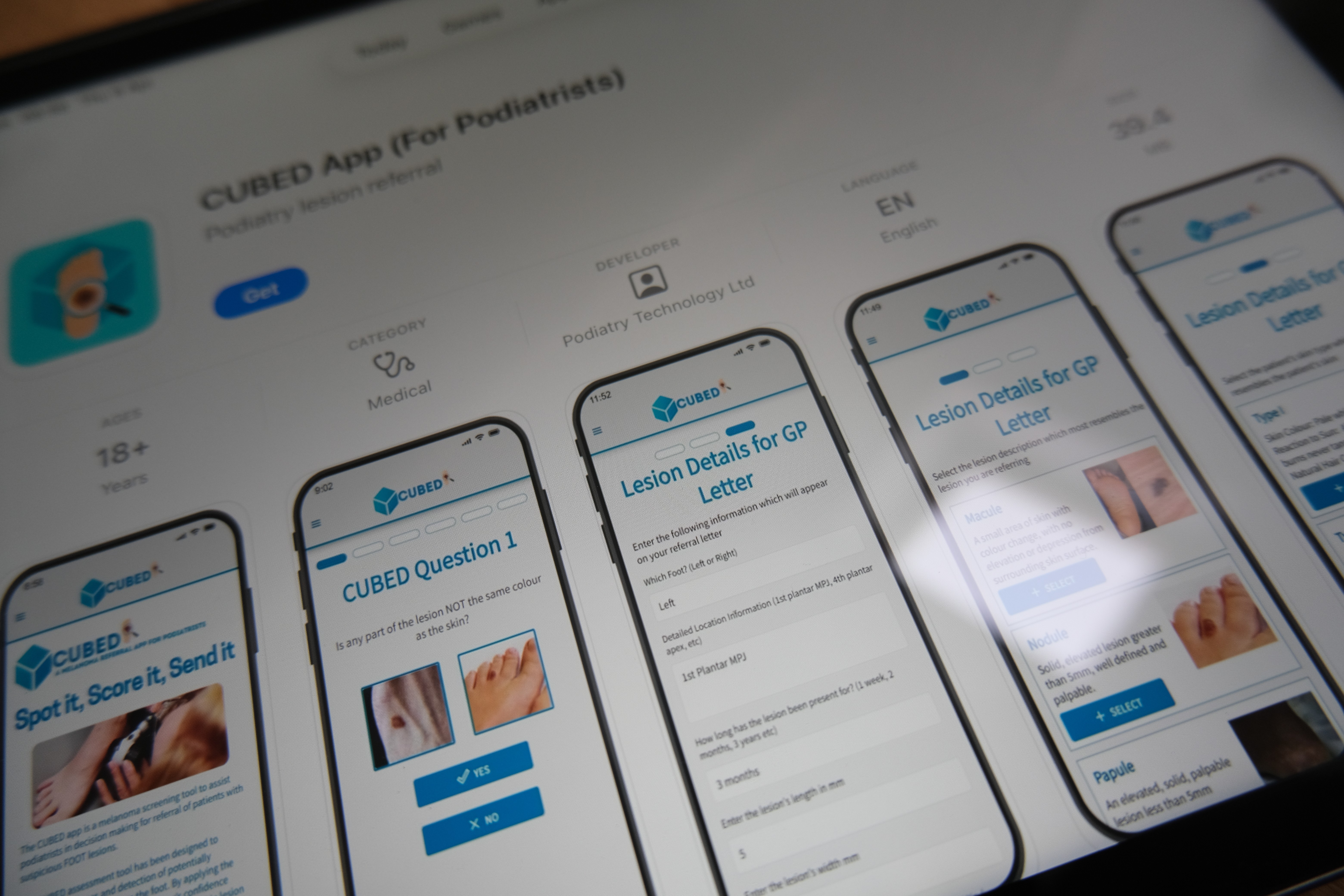
The final product asks clinicians five structured questions based on the CUBED framework. Behind the scenes, however, the system relies on multiple databases and dozens of interface screens to guide users through the assessment process.
“To produce an app with five volunteers in less than six months is a feat that not many software companies could deliver,” Bradshaw reflects. “If it wasn’t for the dedication and enthusiasm of the team, we might not have got this off the ground.”
The app was formally launched at the College’s annual conference in Glasgow last November – although the team admit it was nearly not ready in time – perseverance was needed as the team were determined to iron out all the little bugs and tweaks before rolling the app out.
“Ethics was a fairly lengthy and complicated process, but the experience of Dr Jen Andrews helped us to navigate that area smoothly” Reynolds says. “And ultimately that helped us create a better consent process for both clinicians using the app and the patients involved.”
Early impact
The response from the profession has been encouraging. The app reached over 1,500 downloads shortly after launch, with interest coming from podiatrists in several countries including Australia, Canada, New Zealand, Ireland and Malta.
Early feedback from users has also been positive.
More than 70 peer-reviewed referrals have already been generated using the tool, and 93% of users said it simplified the dermatology referral process. Almost all respondents said they would use the app again.
The development team recently worked on further improvements, with an updated version published last month.
What this means for podiatrists
While digital tools can support clinicians, Reynolds emphasises they are not a substitute for education.
“Podiatrists need to undertake more lesion recognition training,” she says. “The shortage of dermatologists and the pressures on general practice mean other primary care practitioners need to strengthen their knowledge.”
Improved recognition of benign and malignant lesions could help reduce unnecessary referrals while ensuring that suspicious lesions are identified earlier.
Bradshaw agrees that routine skin checks should be part of everyday practice.
“Implementing a simple skin assessment of the full foot and lower limb for every patient should be a priority for podiatrists” she says. “You never know when you might spot a melanoma.”
#SpotItScoreItSendIt
About the interviewees
Michelle Reynolds is a private practitioner with almost 30 years in the profession. She serves on the RCPod’s Special Advisory Group for Dermatology in Podiatry. She is a postgraduate researcher at Health Sciences University, Bournemouth and holds a MSc in Skin Integrity (Dermatology). She is undertaking a PhD investigating dermoscopy use in podiatric practice across the UK.
Sarah Bradshaw has over 25 years of experience in healthcare as a health technology nurse specialist, podiatrist and dermatology nurse. Sarah currently works in Greater Manchester Community Dermatology and is the co-chair of the RCPod’s Special Advisory Group for Dermatology. She holds an MSc in Clinical Dermatology from the University of South Wales.
Acknowledgements
The CUBED app was developed by the Dermatology in Podiatry Special Interest Group at The Royal College of Podiatry. The project was funded by a grant from The College of Podiatry Trust.
Featured Posts



Explore Topics




Related Post

As attention turns to the 2026 World Cup in Canada, Mexico and the United States, we revisit the biomechanics of football boots with UEFA medical specialist Dr Katrine Okholm Kryger – exploring performance, injury risk and why women’s boots still lag behind.