ROYAL COLLEGE OF PODIATRY
Designing for dignity
A podiatry and product design collaboration in India shows how interdisciplinary working, systems thinking and urgency shape practice beyond the clinic.

In a community of 6,000 people in New Delhi, preventable foot wounds still determine whether someone can walk, work or live with dignity. That is the reality at the Village of Hope, a residential community supporting individuals affected by leprosy.
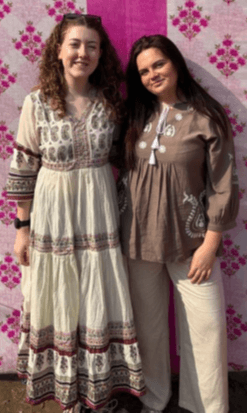
For two weeks in January, Sophie-Jane Hughes-Evans and Sophie Widdows worked there from different but complementary perspectives. Both study at Cardiff Metropolitan University. Sophie-Jane is completing a Master’s in Product Design, while Sophie is a final-year podiatry student.
Together, they assessed cardiovascular risk and explored footwear solutions for residents living with the long-term consequences of leprosy.
Leprosy is a curable chronic infectious disease caused by bacteria. One of its most serious complications is peripheral nerve damage, leading to loss of sensation. Without protective pain signals, minor trauma can progress to chronic foot wounds, often compounded by bone deformity and altered biomechanics.
Despite its low transmission rate and effective treatment, stigma remains profound. Many affected individuals experience social exclusion, reduced employment opportunities and significant barriers to quality of life. Although the World Health Organisation declared leprosy eliminated as a public health problem in India in 2005, the country continues to report more than 100,000 new cases annually.
An overlooked risk
One of the team’s first observations was the absence of routine cardiovascular assessment within the on-site bandaging clinic. While wound care protocols were established, systemic contributors to delayed healing were less visible.
Given the well-documented relationship between vascular health and wound outcomes, this gap was clinically significant. It raised a simple but important question – how many individuals were being treated locally without a fuller understanding of the systemic factors affecting their recovery?
The placement offered an opportunity not only to assess cardiovascular risk but also to support on-site nursing assistants in strengthening their understanding of foot health and wound prevention.
Design and podiatry working together
Designing a footwear system, rather than a single product, proved central to the project.
“We quickly realised that the solution couldn’t be a single piece of footwear,” says Sophie-Jane. “It needed to adapt to different people and to changes in their foot health over time.”
The solution needed to serve individuals at different stages of foot health, accommodate deformity and sensory loss and adapt as conditions improved or deteriorated over time.
Prototyping took place within the clinical environment itself. Concepts were tested rapidly, adjusted in response to feedback and refined to balance comfort, stability and effective pressure redistribution. The aim was not simply to produce a device, but to create a flexible system capable of responding to changing clinical need.
Reflections
Before travelling to India, Sophie-Jane had been designing for one of the community's patients. On arrival, she learned that he had died. The project moved immediately from academic experience to lived reality. It underscored the urgency and responsibility inherent in designing for real people in fragile circumstances, where delay or limitation can carry far-reaching consequences.
For Sophie-Jane, the experience demanded adaptability, not only in navigating unfamiliar cultural and clinical environments, but in recognising that design decisions sit within a much larger interconnected systems of health, poverty and access.
For Sophie, the placement reshaped her understanding of podiatry when it happens beyond the clinic room.
“It made me realise that podiatry isn’t just about what happens in a treatment room,” she reflects. “It’s about helping people maintain independence and dignity in their everyday lives.”
It would be easy to focus solely on biomechanics or pressure redistribution. But in this setting, podiatry was inseparable from dignity and daily function. Appropriate footwear was not simply an intervention, it was a means of preserving mobility, independence and a sense of self-worth.
Many of the residents were living with long-term sensory loss and lower limb deformity. In the UK, access to suitable footwear is often assumed. Here, it could determine whether someone avoided further injury or deterioration.
Working together reinforced the value of complementary expertise. Where podiatry brought clinical insight into wound risk and offloading, design introduced systems thinking and adaptability. The collaboration widened the scope of what felt possible.
The ambition now is to continue developing this work in partnership with The Village of Hope. And it is a reminder of something powerful – that podiatry, at its best, operates not just in clinics but within systems, communities and lives.
Featured Posts



Explore Categories






RCPod Annual Conference
26–28 November
ICC Birmingham
Your place
26–28
Nov 2026
ICC Birmingham
Conference & Exhibition + Immersive Day