

ROYAL COLLEGE OF PODIATRY
The work shaping the Royal College of Podiatry in 2025 and 2026
From careers outreach and growing the workforce, to digital transformation, governance reform and global research influence, 2025 and 2026 have been years of significant organisational change for the Royal College of Podiatry. This long-read is a look at the work the College is doing to modernise and to strengthen its support for members and the profession.

A period of change
Over the past two years, the Royal College of Podiatry has been rebuilding significant parts of the organisation.
From careers outreach and communications to governance, digital infrastructure and professional development.
The work reflects how fast healthcare professions are changing.
Workforce shortages, changing patterns of education, technological transformation and rising expectations around professional support are reshaping the environment in which podiatry now operates.
Across 2025 and 2026, the College’s focus has been on creating a more connected, visible and accessible organisation designed around the future needs of both members and the profession itself.
That work has touched almost every area of the organisation, from careers campaigns and digital systems through to education, research, clinical visibility, governance and communications.
Growing the profession
One of the College’s largest areas of focus during 2025 and 2026 was its careers and outreach work.
Historically, careers activity had developed in a fragmented way, with podiatry promotion spread across multiple campaigns and platforms without a single coordinated strategy.
The College responded by developing a more structured outreach programme supported by a specialist youth engagement agency and a new public-facing campaign identity – Inspire Movement, Choose Podiatry.
The work focused on:
school and college students
university applicants
science and healthcare graduates
career changers from professions including physiotherapy, nursing, sport and the armed forces
Alongside new careers materials and digital advertising campaigns, the strategy placed increased emphasis on video storytelling and direct engagement with practising podiatrists, students and universities.
In 2024, the College attended 16 careers events and engaged more than 10,000 people. Since summer 2025, that outreach work has expanded substantially through national careers events and school leaver festivals.
Together, those activities reached more than 59,000 people and were supported by 55 podiatrists, university staff and students acting as ambassadors for the profession.
The College also invested in targeted digital advertising campaigns across Meta platforms, like Facebook and Instagram, and Google.
Performance data from the Inspire Movement, Choose Podiatry campaign showed:
an average click-through rate of 1.84% across all channels
an average engagement rate of 9.52%
Location-targeted campaigns produced particularly strong click-through performance, while broader national campaigns generated higher overall engagement.
Google advertising campaigns also achieved strong click-through rates through keyword-targeted searches focused on highly relevant audiences.
Early indications suggest the strategy is contributing to substantial growth in podiatry admissions.
Across undergraduate degrees, pre-registration master’s courses and apprenticeships, admissions increased by 28.07% between 2024/25 and 2025/26, rising from 488 to 625 students.
Apprenticeship routes in England saw particularly significant growth, increasing by 63.08% over the same period.
Eleven higher education institutions also reported increases in BSc podiatry admissions, with year-on-year growth ranging from 47.62% to 177.78%.
The work reflects a growing recognition that workforce sustainability requires long-term investment in how the profession presents itself publicly and engages future applicants.
The Inspire Movement, Choose Podiatry advertising campaign.
Early indicators suggest many of these changes are beginning to translate into measurable growth across both the profession and the organisation itself.
At the end of 2025, UK practising membership had increased by 259 members compared with the same period in 2024. This is the first rise in membership numbers since 2018 and the reversal of a seven-year trend.
The increase was described by the College as an encouraging sign that the organisation was beginning to strengthen its relevance, visibility and engagement with the profession.
Alongside workforce and membership growth, the organisation also significantly expanded its public awareness activity during 2025 and 2026.
This included the College’s first national television advertising campaign, broadcast through Sky and Virgin Media video-on-demand services as part of a wider public awareness strategy featuring real-life stories from podiatrists and patients.
The campaign forms part of a broader long-term effort to increase public understanding of podiatry and strengthen the visibility of the profession across digital and national media platforms.

The College's 2025 public awareness campaign advert.
Bringing the profession together
The College also continued investing in professional learning and development through its conferences and events programme.
The 2025 annual conference in Glasgow reflected a growing emphasis on integration, accessibility and multidisciplinary professional identity under the theme:
One profession, one purpose.
The event brought together:
more than 130 sessions
115 speakers
20 hours of CPD
across clinical education, professional development, wellbeing and reflective practice.
The programme included:
clinical updates
hands-on workshops
practical demonstrations
The conference also marked a significant change in how the College approached professional integration by bringing the podiatric surgery conference formally into the core conference programme.
The move helped unify the profession while creating one of the most comprehensive educational programmes the College had delivered.
New formats including Sofa Sessions and Practical Pop-ups were also introduced as part of wider efforts to rethink professional learning through more informal, interactive and discussion-led approaches.
Reflecting on the conference programme, Chair Emma Stoneman said:
“Through research, innovation and collaboration, we continue to raise our standards and strengthen the voice of podiatry within the broader healthcare community. It is our collective expertise, compassion and integrity that will guide the profession into the future.”
The College said lessons from the 2025 event are already helping to shape the plans for the 2026 conference.
Proposed changes include a revised ticket structure, a stronger focus on clinical lectures across two days and a dedicated Saturday programme of practical workshops designed around how members want to learn.
The College’s Specialist Advisory Groups have also played a leading role in developing the conference content for 2026.

Podiatric Surgeon, Ms Rena Francis, leading a practical pop-up session at the Podiatry 2025 conference.
Telling the world about podiatry
One of the College’s most ambitious projects in 2025 and 2026 was the development of a new public awareness campaign designed to raise the profile of podiatry and help more people understand the difference podiatrists’ make to patients’ lives.
Like many major projects, the campaign evolved considerably from its original concept before arriving at a model that better reflected both member priorities and the experiences of patients themselves.
Early concepts focussed on collecting patient stories from across the profession. As the work progressed, the emphasis moved towards a clearer and more focussed public message – helping people to understand how podiatric care enables them to stay active, independent and connected to things that matter most to them.
The result is Super Striders. A campaign built around real patient experiences.
Through video, photography and digital advertising, patients share how podiatric interventions helped them return to activities they value, from work and family life, to hobbies, exercise and everyday independence.
While the main public-facing campaign activity will launch from summer 2026 onwards, the foundations have now been established.
The campaign forms part of a wider strategic programme of work to raise awareness of podiatry, support future workforce growth and help more people understand the profession's role in keeping people active, independent and mobile throughout their lives.
The College would also like to thank SOCKSHOP for its support of the public awareness campaign work. Through this partnership, the organisation has been able to invest in new ways of telling patient stories and raising awareness of the difference podiatric care can make to people’s lives.

An early look at the Super Striders campaign
Recognising practice and achievement
There was a major reimagining of the College's annual awards programme during 2025 and 2026.
Rebuilt from the ground up, the new format was designed to better reflect the diversity of modern podiatry practice and recognise contributions across clinical care, volunteering, research, teamwork, education and leadership, while also celebrating students, rising stars and lifetime achievement.
The reformed programme introduced finalists across every category alongside a new theatre-style awards ceremony intended to create a more visible and celebratory event for the profession.
The changes appear to have generated strong engagement from members, with 151 entries submitted across the awards programme.
Winners will be announced at the ceremony on 12 June.
Strengthening governance
The College carried out substantial programme of governance reform during 2025 and 2026.
This followed member resolutions passed at recent AGMs and subsequent consultation work involving members, Council and external governance advisors from the Good Governance Institute.
The changes included:
amendments to the College’s by-laws
the creation of a new independent Advisory Group
reforms to the President’s role
updated committee structures and terms of reference
new governance processes focused on accountability and transparency
A wider review of committee purpose and alignment also took place, alongside renewed recruitment drives encouraging members to participate in governance and representative work across the organisation.
During this period, the College also increased visibility around Council activity, including the publication of meeting attendance information and ongoing commitments to regular member updates through Chair’s bulletins, Council minutes and webinars.
The work reflects a broader effort to strengthen engagement, accountability and participation across the organisation.
Improving our financial governance
A significant amount of work was also undertaken to strengthen the College’s financial governance and improve organisational resilience.
During 2025 and 2026, new arrangements were introduced to clarify delegated authority and decision-making responsibilities, alongside improvements to procurement processes, budgeting and cashflow management. Greater emphasis was placed on working with departments to improve financial visibility and support more informed planning and investment decisions.
The Finance Committee also underwent reform as part of the wider governance programme, helping to strengthen oversight and accountability.
Although much of this activity is not visible to members, it provides the foundations required for the College to deliver major programmes of work, invest in future services and manage resources responsibly on behalf of members and the profession.
A new strategy for regions and branches
The College begun developing a future strategy for regions and branches as part of its wider governance work. The work is intended to explore how the RCPod’s local networks can best support member engagement, professional development and representation while ensuring they remain sustainable and relevant to the needs of a modern membership organisation.
Further development of this work is expected to continue throughout the current strategy period.
Rebuilding professional development
The College’s work on careers and recruitment has increasingly connected with a broader focus on professional development, career progression and retaining experienced people within the profession.
Alongside attracting new entrants into podiatry, the organisation has also focused on helping members develop skills, expand their scope of practice and build sustainable long-term careers.
As part of a new CPD strategy being developed during the current strategy period, and supported through the College’s wider digital transformation work, the organisation has begun creating a more structured and tiered approach to professional learning and member development.
Part of this work includes creating clearer pathways through different career stages, alongside more accessible educational content, events and professional resources.
The launch of The New Podiatrist forms part of that wider approach.
Rather than functioning simply as a replacement for a print magazine, the publication is increasingly intended to become a central communications and professional engagement platform linking together:
news
professional debate
clinical updates
evidence and research
career development
podcasts and multimedia content
organisational communications
The aim is to create a more responsive and integrated member experience while improving how professional information is shared across the profession.
Within the College’s wider CPD strategy, The New Podiatrist acts as an accessible gateway into professional learning and development. More structured forms of CPD, including conferences, online learning, courses and specialist educational events, sit alongside it as part of a broader tiered approach to professional education and career progression.
In 2025, the College also launched a pilot student hub for the first time, designed to give podiatry students easier access to careers information, educational resources, professional guidance and community support.
The project forms part of the wider digital transformation programme and is expected to become a permanent feature of the new Royal College of Podiatry website.
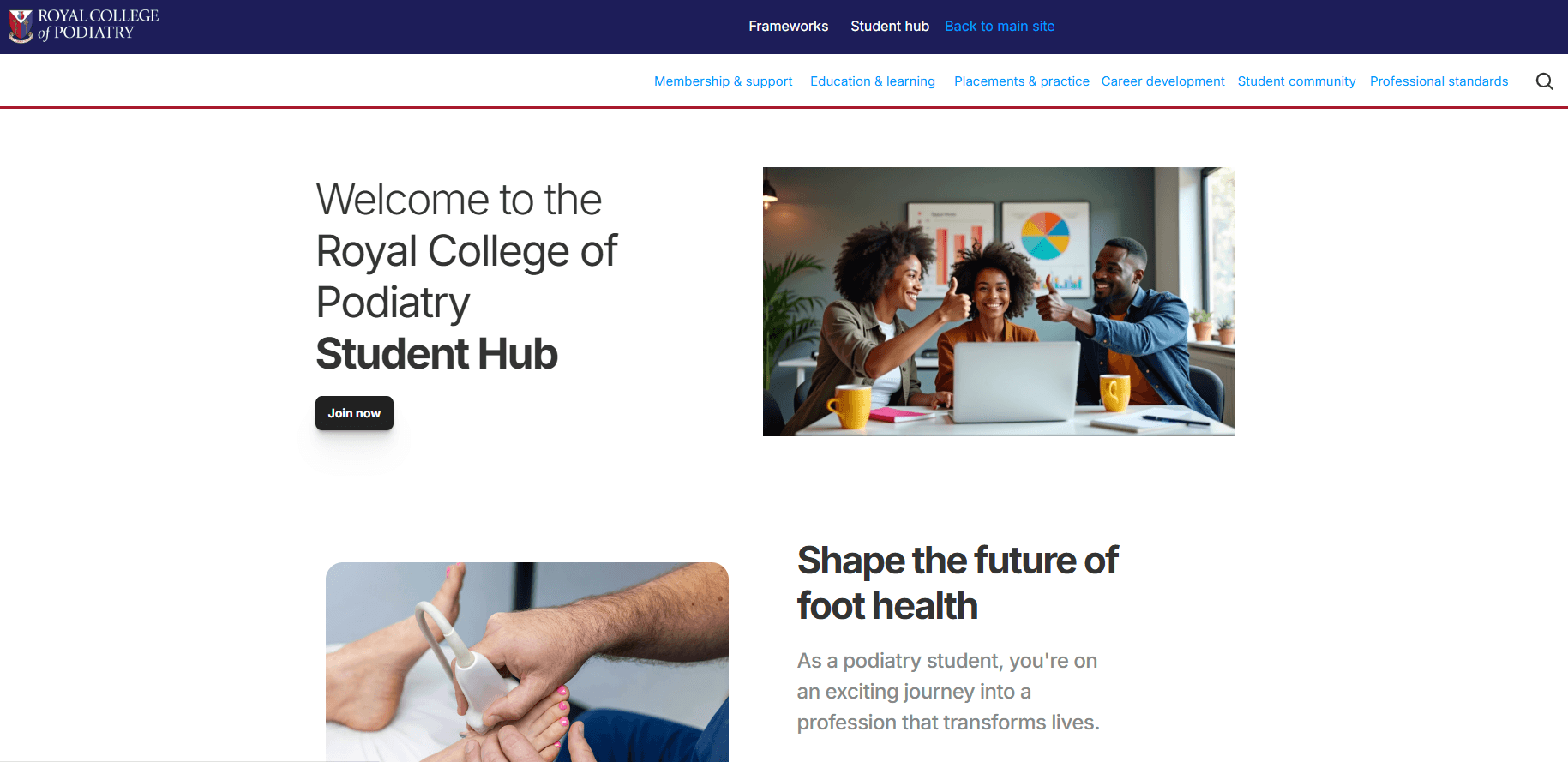
The Student Hub – a project that will be integrated into to the College's new website as part of its digital transformation project.
Supporting members at work
Alongside professional development activity, the College continued supporting members through its professional support, trade union and employment relations work.
Professional Support Officers are currently assisting more than 243 cases, alongside wider workplace concerns and professional practice issues.
Across the UK, the College’s network of 138 NHS representatives and local branch structures also continued supporting members at workplace level across all four nations.
The organisation also continued its work on:
NHS pay negotiations
workplace wellbeing
employment relations
independent practice support
CPD and professional standards
equality, diversity and inclusion
During 2025 and 2026, the College also commissioned an external review into its equality, diversity and inclusion work. That review directly informed several organisational changes, including the recruitment of a dedicated Environmental, Social and Governance (ESG) Officer to help lead future development in this area.
During 2025 and 2026, the College continued contributing to national trade union and workforce debates through the TUC Congress.
At the 2025 TUC Congress, College delegates spoke on issues including:
NHS workforce shortages
career progression for allied health professionals
workplace protections for nursing parents
occupational health risks
player wellbeing in elite sport
The College also supported wider motions connected to air quality, workplace safety and staff wellbeing.
Several contributions focused directly on workforce sustainability within podiatry and the wider NHS. Speaking during a debate on retaining and valuing the NHS workforce, diabetes specialist podiatrist Khansah Imitaz warned that continued erosion of training opportunities for smaller professions could have serious consequences for prevention-focused healthcare and patient outcomes.
Alongside this work, the College continued contributing to wider debates around advanced practice, workforce deployment and multidisciplinary care within the NHS.

Royal College of Podiatry Deputy General Secretary, Martin Furlong (middle), pictured with RCPod members Khansah Imitaz (L) and Lauren Thompson (R) while representing the College at the TUC Congress 2025.
Strengthening podiatry's voice across the UK
Alongside its work on workforce development, communications and professional support, the College increased its policy and public affairs activity across all four UK nations during 2025 and 2026.
Through engagement with governments, parliamentarians, NHS bodies and allied health professional networks, the College worked to ensure podiatry was represented in discussions around workforce planning, prevention, primary care and health inequalities. Activity included influencing workforce and education policy, contributing to consultations and national strategies, engaging with elected representatives and supporting the development of new models of care.
Research influence and global reach
The College’s academic and research profile also continued to grow during 2025 through the Journal of Foot and Ankle Research (JFAR), the official journal produced jointly with the Australian Podiatry Association.
Publisher data from Wiley showed significant growth in readership, submissions and international reach during the year.
Full-text article views increased by 36.9% in 2025, substantially above the average growth seen across comparable surgical and specialist journals.
The journal also saw a 47.9% increase in submissions compared with the previous year, receiving 433 submissions during 2025.
Research published in the journal was accessed globally, with the highest readership coming from:
the United States
China
Australia
the United Kingdom
Japan
Spain
India
The average article published in JFAR during 2025 received 656 views, more than double the average for comparable journals in the same subject area.
The journal also generated 858 Altmetric mentions across news outlets, social media and online platforms.
Among the most widely read papers during the year were research articles focused on:
diabetic foot complications
exercise and rehabilitation
ankle instability
orthoses
tendon management
The figures reflect growing international visibility for podiatry research and increasing engagement with evidence-based practice across the profession.
Investing in digital transformation
One of the largest pieces of work currently underway at the College is a major programme of digital transformation.
While the organisation recorded good website traffic and digital engagement during 2025 and 2026, internal reviews identified longstanding frustrations with fragmented systems, disconnected platforms and inconsistent and poor user experiences.
The College has therefore committed significant investment towards rebuilding its core digital infrastructure.
This includes:
a new website
a new customer relationship management (CRM) system
a new events platform
a new awards nomination platform
improved communications systems
integrated membership and booking systems
AI-supported search functionality
All of these products and services will come together on the Ready Membership platform.
The aim is not simply to replace old systems, but to create a more reliable and connected experience for members while improving how staff access and manage information internally.
Historically, staff often worked across disconnected systems, with inconsistent data and limited confidence in the reliability of information held across platforms.
The new infrastructure is intended to simplify how members interact with services including:
event bookings
awards nominations
membership management
email communications
CPD access
The organisation is also exploring how AI-supported tools may help improve access to information by generating summarised search results and streamlining navigation across large volumes of professional content.
Rethinking communication
Alongside digital transformation work, the College has also been reviewing how it communicates with members.
While newsletters and social media remain important parts of the organisation’s communications approach, internal reviews identified that many communication channels had developed separately over time without clear integration.
One of the major drivers behind The New Podiatrist was therefore to centralise and strengthen the College’s communications approach.
Increasingly, content published through The New Podiatrist will help shape wider communications activity, including newsletters, social media and broader member engagement campaigns.
At the same time, the College’s core website is expected to evolve into a more stable and structured information platform focused on evergreen content, professional guidance and highly searchable resources built around Government Digital Service principles for writing and structuring information online.
The aim is to create clearer distinctions between:
news and professional commentary
permanent professional guidance and resources
The College’s existing newsletters continued to perform strongly throughout 2025 and into 2026, achieving an average open rate of 57.26% alongside an average click-to-open rate of 11.59%.
At the same time, The New Podiatrist began establishing itself as a new platform for professional engagement and long-form digital content, reaching readers across 20 countries and five continents during its early launch period.
Early engagement metrics suggest audiences are spending substantial time with in-depth professional content.
Average time spent on articles published through The New Podiatrist reached 6 minutes and 8 seconds, compared with 2 minutes and 35 seconds on the College’s main website.
During its initial launch period, the publication recorded:
5,715 article reads
4,600 unique visitors
12,000 page views
Meanwhile, the Royal College of Podiatry’s main website attracted more than 57,000 users across 141 countries during 2025 and 2026.
Work to integrate The New Podiatrist more fully into the College’s wider communications ecosystem, including newsletters, social media and audience distribution systems, will continue throughout 2026 as the digital transformation develops.

The New Podiatrist includes news, features and interviews.
Refreshing the College brand
The College has also been undertaking a broader review of its organisational identity and visual branding.
Working with specialist designers, the organisation has been developing a refreshed brand system intended to modernise and unify the College’s growing range of platforms, campaigns and sub-brands.
This includes work across:
the Royal College of Podiatry identity
The New Podiatrist
Inspire Movement, Choose Podiatry
Arch Support
the College of Podiatry Trust
Some early elements of the redesign, including typography and masthead work, are already visible within The New Podiatrist.
The wider rollout is expected to continue throughout 2026 with a particular focus on accessibility, consistency and improving the visual experience across member-facing platforms and communications.
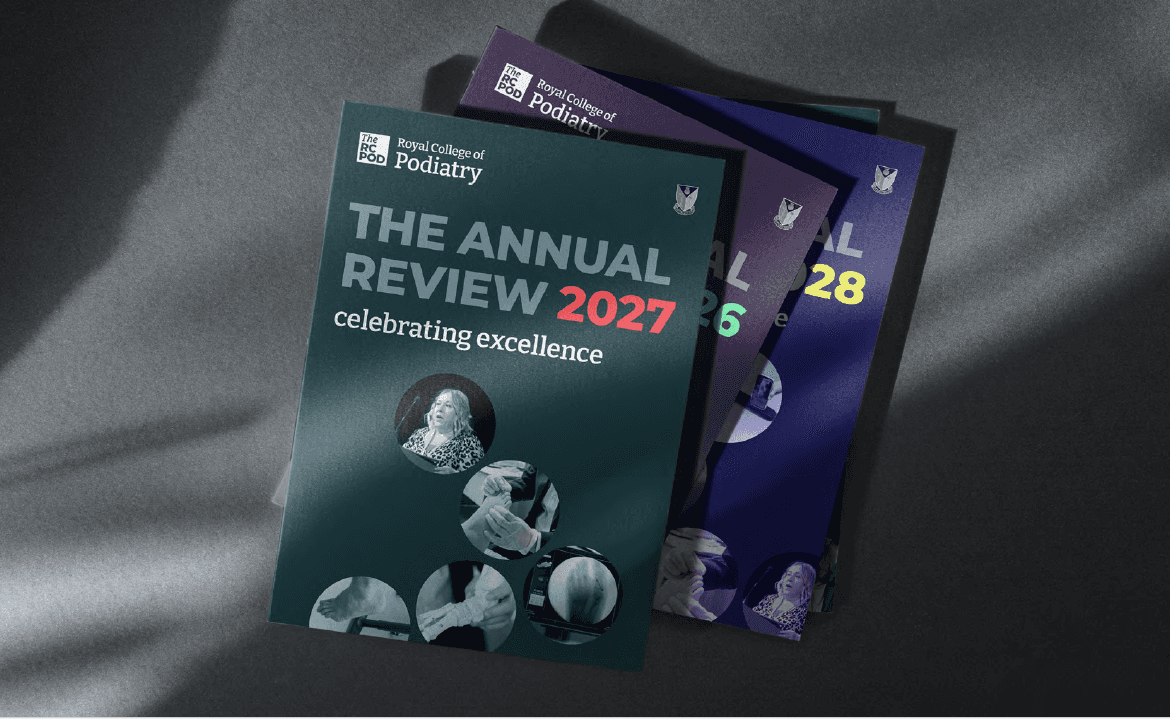
An early look at the College's brand refresh.
Building a more connected organisation
Alongside outward-facing projects, the College has also spent much of 2025 and 2026 reviewing its internal structures and staffing.
This has included targeted restructuring and recruitment work aimed at strengthening departments directly linked to member services, governance and organisational development.
Changes have included:
expanding membership and events staffing
creating a dedicated Environmental, Social and Governance (ESG) role
introducing a full-time HR and Training Officer position
refining work across education, employment relations and partnerships teams
establishing a dedicated content team supporting organisational work and The New Podiatrist
The work is intended to ensure departments are better aligned with strategic priorities while improving support for members and staff development internally.
A further organisational review is expected to continue later in 2026.
A new advisory group to provide independent advice
Another major development during this period has been the creation of a new Advisory Group bringing independent expertise into the College’s governance structure.
The appointments follow a recent AGM resolution from members calling for the establishment of an advisory body providing strategic insight and external challenge.
The five appointed advisors come from backgrounds including:
healthcare leadership
public affairs
governance
employment relations
charity law
higher education
The College said the group is intended to strengthen governance by introducing broader external perspectives into strategic decision-making while supporting the organisation’s long-term development.
The Advisory Group operates in an advisory capacity, with the College’s Council remaining the organisation’s formal decision-making body.

(Members of the group (left to right): Mark Dickinson, Ruby Lake, Lenny Rolles, Moira Swinbank OBE and Professor Stella Vig.)
Looking ahead
Many of the changes currently taking place across the Royal College of Podiatry are connected.
Careers outreach links to workforce sustainability. Digital transformation links to member experience. Professional development links to retention. Communications reform links to engagement and accessibility.
Taken together, they reflect an organisation attempting to modernise not only its systems, but also how it supports members and communicates with the profession in a fast-changing healthcare environment. The Royal College of Podiatry is becoming more modern, more outward-facing and more willing to experiment.
Much of this work remains ongoing. Much of this work is not yet finished.
Much of this change is also happening while staff continue delivering the College’s day-to-day work using systems and infrastructure that are often outdated, fragmented and difficult to work with.
The College’s direction of travel is to create a more connected, accessible and responsive organisation designed around the current and future needs of both members and the profession.
Featured Posts


Explore Categories






RCPod Annual Conference
26–28 November
ICC Birmingham
Your place
26–28
Nov 2026
ICC Birmingham
Conference & Exhibition + Immersive Day